
7 Things Your Houseplants Are Telling You
Beyond watering: seven surprising truths about houseplants, from how they signal stress to how they adapt to life indoors. Useful across Western Pennsylvania.
PITTSBURGH PLANT CARE
A. Reihl
1/26/20265 min read
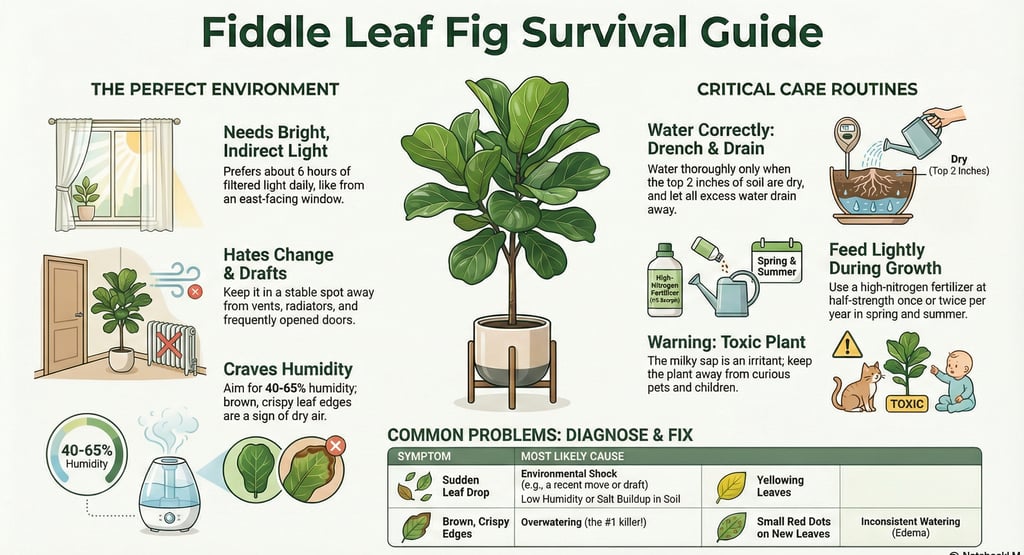
Beyond Watering: 7 Surprising Truths Your Houseplants Have Been Hiding
TL;DR: You've invested $5,000-$15,000 in premium specimens based on Instagram aesthetics. Half are declining because generic care advice ignores their evolutionary biology and Pittsburgh's hostile indoor climate. A botanical consultation and white-glove maintenance protect your investment while ensuring museum-quality displays year-round. Schedule Your Elite Botanical Assessment.
Your Fox Chapel estate showcases a $12,000 botanical collection. Rare Monstera Thai Constellation. Mature Fiddle-Leaf Fig. Vintage Rubber Plant. Collectible Philodendrons.
Eighteen months later, the Fiddle-Leaf Fig dropped 60% of its leaves. The Thai Constellation stopped fenestrating. The Rubber Plant looks leggy and weak.
You've lost $6,000+ in specimen value.
You followed every care guide. Hired cleaning crews to water. Bought premium soil and containers.
Here's what luxury plant retailers don't tell you: Evolutionary biology and Pittsburgh's specific climate conditions create care requirements that generic advice, and well-meaning staff, completely miss.
Your premium specimens aren't just decoration, they're living investments requiring horticultural expertise most homeowners and retail nurseries simply don't possess.
1. Soil is Optional: The Aerial Revolution
The clandestine assembly of botanical rebels known as Tillandsia, or Air Plants, challenges the very foundation of traditional gardening. To the average enthusiast, "planting" is synonymous with "potting," but these epiphytic wonders have staged an evolutionary coup against the earth itself. In their native habitats, they cling to tree canopies, living entirely without soil.
Because they lack traditional root systems for nutrient uptake, they receive their sustenance through a specialized "Aerial Revolution." They utilize microscopic structures on their leaves to capture moisture and nutrients directly from the atmosphere.
"Air plants are one of the most unusual options you can grow in your house because they don’t need soil or a potting mix... they actually get both nutrients and water through their leaves."
For the lifestyle gardener, this shifts the care paradigm from soil management to atmospheric maintenance. Success depends on regular misting or deep-soaking, ensuring the leaves, not the nonexistent roots, absorb the hydration they require.
2. Your "Banana Tree" is Actually a Giant Herb
Botanical nomenclature is often a minefield of misnomers that lead to significant care errors. Take the "Banana Tree," for instance. Despite its towering height, it is botanically a giant herb. The sturdy-looking "trunk" is actually a "pseudostem," a tightly packed collection of overlapping leaf bases rather than true wood.
We see a similar deception in the "Asparagus Fern." Despite its feathery, fern-like appearance, it is actually a member of the lily family and is technically a South African bush. Unlike true ferns that reproduce via spores and demand high humidity, this bush is a hardy survivor with a hidden secret: its roots are so powerful and aggressive that they have been known to shatter ceramic pots as they expand. These common names often mask the true biological needs of the plants we bring into our homes.
3. The Ancient Science of Cloning in Your Kitchen
Every time you take a cutting from a favorite plant, you aren't just growing a new specimen; you are participating in an ancient form of genetic cloning. This process of asexual propagation allows a plant to pass down its exact genetic blueprint, but it offers something even more profound for the home gardener: "epigenetic memory."
Cuttings retain heritable patterns of phenotypic differences, essentially "genetic wisdom", from the parent plant. If you take a cutting from a plant that has successfully adapted to your specific home's low light or drafty corners, that "child" is born with the advantageous stress response priming necessary to thrive in those exact conditions.
"Propagating plants from cuttings is an ancient form of cloning... plantlets from the excised stem cuttings and leaf cuttings, broken off in the natural environment, are more successful."
Succulents have perfected this art, using carbon and water stored in their fleshy leaves to form "adventitious roots", roots that spring from non-root tissue, allowing them to colonize even the most inhospitable environments.
4. The Plants That "Talk" Back
Successful indoor horticulture requires a responsive dialogue. Certain species are celebrated as "good communicators" because they offer immediate visual signals when their microclimate is suboptimal. Listening to these signals can turn a beginner's guesswork into master-level care.
Maranta (Prayer Plant): These plants exhibit nyctinasty, moving their leaves vertically like hands in prayer as the light fades. If the leaves fail to open in the morning, your light levels are too low; if the bright patterns begin to fade, the light is too intense.
Philodendron: These are the poets of the plant world. Yellowing leaves are a rhythmic cry against overwatering, while "legginess", excessive space between leaves on the stem, is a clear sign the plant is stretching toward a distant light source.
Peace Lily: Famous for its dramatic "fainting" spell, this plant will droop entirely when thirsty. While it revives quickly, a Master Horticulturist knows that frequent wilting causes long-term stress.
5. The "Cast-Iron" Survivalists vs. The Finicky Classics
Not all inhabitants of the indoor jungle are created equal. Some are "Victorian parlor survivors," like the Cast-Iron Plant, which earned its name by enduring the dim light and coal-smoke of 19th-century London. Others are high-maintenance "Divas" that require a precise environmental theatre to stay alive.
The Survivors (Cast-Iron, Snake Plant, ZZ)
The Divas (Fiddle Leaf Fig, Anthurium, Begonia)
Durability: High tolerance for low light and drought; thrives on "controlled neglect."
Sensitivity: Highly reactive to drafts, temperature swings, and inconsistent watering.
Root Strength: Includes "honorable mentions" like the Asparagus Fern, whose roots can break pots.
Metabolic Demand: Requires high humidity and specific light intensities to avoid leaf drop.
6. Succulents Aren't All Desert Dwellers
The "Ponytail Palm" is a classic victim of the botanical mislabeling we explored earlier; it is neither a tree nor a shrub, but a desert succulent that stores water in its bulbous trunk. However, we must not fall into the trap of assuming all succulents crave the desert sun.
The "Christmas Cactus" is a tropical succulent that breaks every rule in the book. It does not tolerate drought and requires cooler temperatures, ideally 55°F, to trigger its winter blooms. Master Tip: If your cactus refuses to flower despite the cool air, keep it in total darkness for several weeks. This environmental stressor mimics its native tropical rhythms and forces the initiation of its stunning floral display.
7. The "Toxic Beauty" Paradox
There is a profound irony in the air-purifying plants we bring into our homes. The very species NASA famously recommended in its Clean Air Study for their ability to filter formaldehyde and benzene, most notably the Snake Plant and Peace Lily, are the same ones I must warn you to keep away from "prying paws."
These plants, along with the iconic Monstera deliciosa, employ a chemical defense mechanism: insoluble calcium oxalate crystals. While the Monstera is an evolutionary marvel that developed "fenestrations" (holes in its leaves) to allow rainforest winds and light to pass through, it is also a "Toxic Beauty."
"All parts of Monstera deliciosa contain insoluble calcium oxalate crystals. If ingested, these needle-like crystals cause immediate oral pain, swelling of the throat, and gastrointestinal distress."
If you notice your Monstera developing yellow leaves or crispy brown edges, it may be struggling with its environment, but if a pet decides to sample the foliage, the plant’s ancient biological defenses will strike back with needle-like precision.
Rethinking Your Indoor Garden
Understanding these hidden truths shifts the perspective of indoor gardening from a chore to a study of biological resilience. When we recognize that a "tree" might be a herb, or that a cutting carries the wisdom of its ancestors, we become better equipped to steward the life in our care.
The next time you walk through your home, look closer at your collection. Are you just decorating your space with greenery, or are you ready to start listening to the ancient, silent language of the jungle living in your living room?
Schedule Your Elite Botanical Assessment | Read More Luxury Plant Care Insights
Plantburgh | Elite Botanical Curation & Museum-Quality Maintenance | Serving Pittsburgh's Premier Properties
Plantburgh®
Rooted in the 412.
Contact
contact@plantburgh.com
(412) 576-7894
© 2026 Plantburgh LLC. All rights reserved.
Hours
By appointment
Location
Pittsburgh, PA
Who We Serve
